
Use uf gpa calculator to compute your University of Florida semester, cumulative, or target GPA, applying official plus/minus grades, repeat rules, and S/U policies.
| # | Course | Credits | Grade |
|---|
Enter your courses above.
Course Breakdown
How to Use the UF Grade Calculator
- Select Your Mode: Choose Cumulative (to include prior UF credits), Semester (for current classes only), or Goal GPA (to find the grades needed for your target GPA).
- Enter Prior GPA (Optional): Input your existing UF cumulative GPA and earned GPA-carrying credit hours.
- Add Your Courses: Select the credit hours and expected letter grade (A through E, or S/U) for each class.
- View Instant Results: Your exact UF GPA updates automatically—truncated to two decimal places without rounding, matching your official ONE.UF transcript.
UF calculates GPA by multiplying each course’s grade point value by its credit hours, adding those totals together, then dividing by your total GPA-carrying credit hours using a plus/minus scale where A- equals 3.67 and B+ equals 3.33, not the rounded 3.7/3.3 or 4.0/3.5 values many students expect from other schools.
UF doesn’t use a simple 4.0 scale. It operates a plus/minus system, so an A- is worth slightly less than a full A, and a B+ is worth slightly more than a flat B. Here’s the actual math behind it: multiply each course’s grade point value by its credit hours, add those numbers up, then divide by your total GPA-carrying credit hours. That’s it. No weighting for difficulty, no bonus for upper-division courses. A three-credit A in an intro elective moves your GPA exactly as much as a three-credit A in organic chemistry, which frustrates a lot of pre-med students until they get used to it.
How UF Calculates GPA
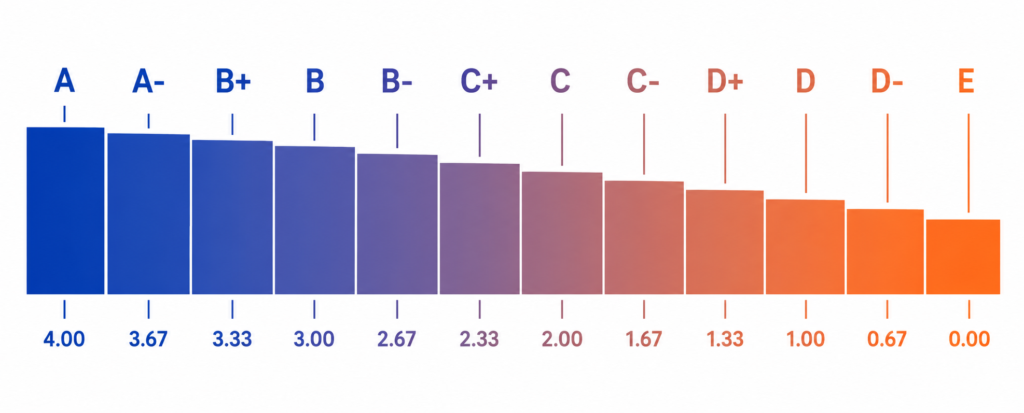
UF calculates GPA by multiplying each course’s grade point value by its credit hours, adding those totals together, and dividing by your total GPA-carrying credit hours. University of Florida uses a strict plus/minus scale where an A- equals 3.67 and a B+ equals 3.33—not the rounded 3.7 or 3.5 values used at some other schools.
Every course carries equal weight per credit hour regardless of difficulty. A three-credit A in an introductory elective moves your GPA by the exact same amount as a three-credit A in organic chemistry, with no extra bonus points for upper-division classes.
Official UF GPA Scale
| Letter Grade | Grade Points | Letter Grade | Grade Points |
|---|---|---|---|
| A | 4.00 | C+ | 2.33 |
| A- | 3.67 | C | 2.00 |
| B+ | 3.33 | C- | 1.67 |
| B | 3.00 | D+ | 1.33 |
| B- | 2.67 | D | 1.00 |
| D- | 0.67 | ||
| E | 0.00 |
For a complete percentage breakdown and passing grade rules, view our full UF Grading Scale guide
Grade values are verified against the UF Undergraduate Catalog, Grades and Grading Policies, last updated July 2026.
What Counts Toward Your UF GPA
S/U grades—along with W, AU, I, H, and NG—carry zero grade points and are excluded from your UF GPA calculation, even when S/U credits count toward degree completion. For repeated courses, UF awards credit only once but keeps both the original and new grades in your cumulative GPA.
Many students assume retaking a class erases the old grade, but UF does not offer grade replacement. For example, if you earn a D+ in Calculus 1 and later retake it for a B, both grades remain factored into your GPA math. While a strong retake still boosts your average, the original grade never disappears from your transcript.
Additionally, UF truncates your GPA at two decimal places without rounding up. If your exact average is 3.248, your official transcript displays 3.24—and this calculator follows that exact rule.
UF GPA Requirements You Should Know
UF requires a 2.0 cumulative GPA to graduate and remain in good academic standing. Most colleges within UF use roughly a 3.5 cumulative GPA as the Dean’s List threshold, though the exact figure varies by college and semester credit-hour load.
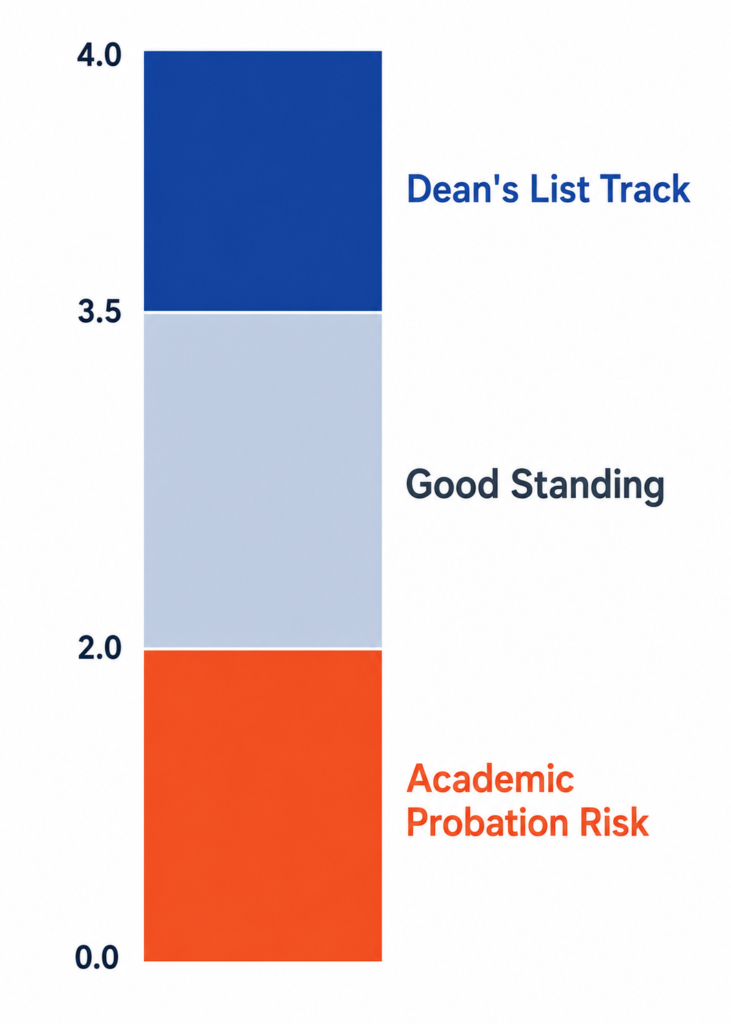
- 2.0 — minimum cumulative GPA to remain in good standing and graduate.
- 3.5 — typical minimum for Dean’s List consideration (varies by college).
- 3.5+ — general range for cum laude and higher Latin honors at graduation.
These numbers aren’t identical across every college at UF; for instance, can run stricter than CLAS’s. If you’re sitting close to any of these thresholds, it’s worth a short email to your advisor rather than assuming.